

The Truth About Piriformis Syndrome
I've never had a true case of piriformis syndrome in my office.
For those of you who have been previously diagnosed with this condition, this is going to be controversial. Now, I can't say with absolute certainty that I've never had a case because I've treated a lot of patients over the years. Perhaps I am forgetting one. But, this condition is rare and overdiagnosed and I can't think of a single one in recent memory. How can this be? For those of you that have never heard of this condition, let's start by explaining what the piriformis and piriformis syndrome is.
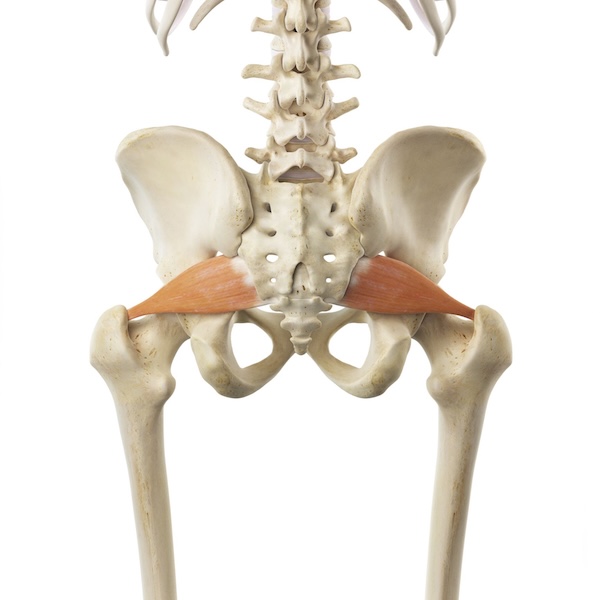
The piriformis is a small pear-shared muscle (that's where it gets the name) located on the backside of your hip, near the glutes. Piriformis syndrome occurs when your piriformis muscle compresses your sciatic nerve and results in inflammation. It can cause pain or numbness in your buttock and down the back of your leg. It can happen on one side of your body or both.
Now you might be saying to yourself, "wait, but I do have that!" Sciatica is a symptom, not a diagnosis, and other more common conditions can also cause sciatica. For example, a low back disc herniation or disc bulge can cause sciatica and is far more common. Actually, almost every case that a patient tells me they have piriformis syndrome, it usually turns out to be a low back disc issue. Research says that only about 0.3% of cases of sciatica are a result of piriformis syndrome. That's pretty rare.
What's the Difference Between Piriformis Syndrome and Disc Herniation?
While both conditions can produce the symptom known as sciatica (pain and/or numbness and tingling going down your leg), the source of the nerve irritation is different. In piriformis syndrome, the site of irritation occurs below the level of the spine. Once your spinal cord reaches the end of the spine, the nerve splits into two branches that travel down each leg. At this point, this nerve is now called the sciatic nerve. As the sciatic nerve travels into the hip and down the leg, it must pass above, below, or through the piriformis muscle.
For your piriformis to squeeze on your sciatic nerve and cause sciatica via piriformis syndrome, your sciatic nerve must pass through the piriformis. Studies show that in approximately 10% of people the sciatic nerve travels through the piriformis. This prevalence is affected by race, with east Asians having a higher chance of this variation. That means for approximately 90% of the population, it is anatomically impossible to experience piriformis syndrome.
On the other hand, disc bulge or disc herniation is an extremely common condition. Here's the prevalence of some form of disc degeneration according to research:
- The prevalence of disc degeneration ranged from 37% in asymptomatic individuals in their 20s to 96% of those in their 80s.
- Disc signal loss was present in over 50% of individuals older than 40 years and by 60 years, 86% of individuals had signal loss of scans.
As you can see, disc degeneration is a far more common condition, even in young people without symptoms. In disc degeneration, the source of the nerve irritation begins in the spine, as opposed to below it. While the symptoms are very similar, the treatment different. Because the symptoms often manifest as pain in the hip or glute, people tend to think that's where the source of the injury is. Instead, the origin of the injury is further up, even if there is no back pain present. Treatment to the low back is still required to alleviate this condition. Treatment to the low back for piriformis syndrome would not solve the issue.
How Can You Tell Without Imaging?
If you've already been a patient at my office, you know that I almost never refer for imaging on the first visit. In fact, current medical recommendations discourage it for non-traumatic injuries without red flags in the history. In the vast majority of circumstances, I can be confident in my diagnosis based on my medical history and examination findings. Of course there are some exceptions, such as traumatic injury, which often require imaging to rule out dangerous circumstances that cannot be delayed.
So, however rare piriformis syndrome is, how can I be sure that you don't have it? Because if during the exam mobilization or treatment of the low back affects the symptoms, then the source is higher up the chain than the piriformis, and we can be sure that the source is in the spine. Like I said, the condition is rare enough that we almost always start with evaluation of the low back and see if it affects things. If not, then we can work further down the chain and continue from there.
But if anyone in the future diagnoses you with piriformis syndrome, please come see me immediately so I can see my first case! However, chances are, I doubt it!
